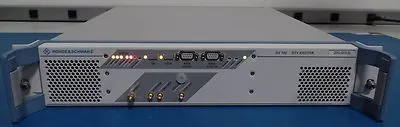
Rohde and Schwarz UPL Overview
Audio Analyzer UPL performs practically all types of analog measurement, from frequency response measurements through to externally controlled sweeps with reference traces, determination of 3rd-order difference frequency distortion, spectral display of demodulated wow and flutter signals, etc. In contrast to many other audio analyzers, UPL is capable of performing real dual-channel measurements in the audio-frequency range, ie there is no need for switchover between two inputs and this facility is not limited to a few special cases. The generator is every bit as versatile: it supplies any conceivable signal from sinewave and noise signals through to multi-sinewave signals comprising up to 7400 frequencies. In addition to all this, UPL features excellent technical data: analog sine-wave generation with harmonics of typ. -120 dB, spectrum displays with a noise floor below -140 dB for analog and -160 dB for digital interfaces, FFT with a maximum frequency resolution of 0.05 Hz, etc. UPL provides signal monitoring via loudspeaker during the test, jitter measurements on digital audio signals, resynchronization of jittered digital audio signals by means of a jitter-free clock signal, and many more features.
Superior analysis concept
UPL performs all measurements using digital signal processing. Analog signals to be tested undergo elaborate preprocessing before they are digitized and measured by means of digital routines. For example, in THD measurements, the fundamental wave is attenuated by means of a notch filter and the residual signal amplified by 30 dB before it is digitized. In this way, the dynamic range can be extended beyond that offered by the internal 20-bit converter. This provides the scope required for measuring future converters, which will be technically more advanced than present-day devices. This concept guarantees a performance and flexibility by far superior to instruments providing purely analog or digital measurements. The above measurement concept offers many more advantages over merely analog concepts: The test routines performed on analog and digital interfaces are identical. This allows, for instance, the direct comparison of IMD measurements made ahead of and after a converter. All test functions are available both on the analog and the digital interfaces. This makes it possible to measure at any point of a common analog and digital transmission path. Only this ensures efficient and complete testing. The filters, too, were implemented digitally, resulting in an infinite number of filters as it were, and this also for measurements on analog interfaces. Just choose the type of filter (eg highpass), cutoff frequency and attenuation: that’s all you have to do to loop a new filter into the test path. In intermodulation measurements, spurious components are measured selectively for all frequencies in accordance with the mathematical formula of the relevant test standards. This procedure avoids the measurement of adjacent components along with the spuria, which is usually inevitable with analog test methods. Measurement speed is as a rule higher than with analog techniques since digital test routines can adapt their speed to the input frequency. And – last but not least: Operation is the same for the analog and the digital interfaces. A feature that should not be underestimated.
UPL performs all measurements using digital signal processing. Analog signals to be tested undergo elaborate preprocessing before they are digitized and measured by means of digital routines. For example, in THD measurements, the fundamental wave is attenuated by means of a notch filter and the residual signal amplified by 30 dB before it is digitized. In this way, the dynamic range can be extended beyond that offered by the internal 20-bit converter. This provides the scope required for measuring future converters, which will be technically more advanced than present-day devices. This concept guarantees a performance and flexibility by far superior to instruments providing purely analog or digital measurements. The above measurement concept offers many more advantages over merely analog concepts: The test routines performed on analog and digital interfaces are identical. This allows, for instance, the direct comparison of IMD measurements made ahead of and after a converter. All test functions are available both on the analog and the digital interfaces. This makes it possible to measure at any point of a common analog and digital transmission path. Only this ensures efficient and complete testing. The filters, too, were implemented digitally, resulting in an infinite number of filters as it were, and this also for measurements on analog interfaces. Just choose the type of filter (eg highpass), cutoff frequency and attenuation: that’s all you have to do to loop a new filter into the test path. In intermodulation measurements, spurious components are measured selectively for all frequencies in accordance with the mathematical formula of the relevant test standards. This procedure avoids the measurement of adjacent components along with the spuria, which is usually inevitable with analog test methods. Measurement speed is as a rule higher than with analog techniques since digital test routines can adapt their speed to the input frequency. And – last but not least: Operation is the same for the analog and the digital interfaces. A feature that should not be underestimated.